- Nov 20
- By YeHZ
A rooftop tent solves the ground problem: no stakes in frozen soil, no clearing a platform, no sleeping at the temperature of the earth. It solves nothing else. Winter nights fail for three measurable reasons — conductive loss, moisture, and load — and each has a fix that works better than buying a warmer bag.
In this guide
- Cold, Condensation, and Snow: What to Plan For
- How to Stay Warm Without Trapping Moisture
- Which Rooftop Tent Shell Suits Your Winter Trips?
- Extra Gear for a More Comfortable Winter Camp
- Keeping Batteries, Water, and Food Ready in the Cold
- Your Five-Step Winter Camping Checklist
- Winter Rooftop Tent Camping FAQ
- Get Ready for Your Next Winter Trip
- Sources and Further Reading
Cold, Condensation, and Snow: What to Plan For
Frozen ground is an unlimited heat sink
Heat flows to whatever colder mass it touches, and frozen soil draws continuously. That is why pads carry an R-value, now measured under ASTM F3340: R-1 to R-2 for warm nights, R-5 and up for snow. A roof tent removes the conductive path by lifting you off the ground, which is worth roughly one pad rating. It does not make you insulated — the cold now arrives by air and by radiation instead.
The water you exhale has to go somewhere
A sleeping adult releases close to half a litre of vapour overnight. It condenses on the coldest surface, which in a shell is usually the panel above your face, and at −10 °C that frost melts onto your bag by morning. Sealing the tent does not stop this; it concentrates it. The fix is a low intake vent plus a high exhaust vent so vapour leaves before it reaches the dew point.
Snow arrives while you are parked
Ten centimetres of dry snow adds about 5 kg per square metre; wet snow about 15 kg; settled snow closer to 25 kg, per roof snow load reference tables. On a two-square-metre shell that is 30–50 kg overhead — static load while parked, dynamic load the moment you drive. Clear it first, and never open a shell with a snow load on top.

How to Stay Warm Without Trapping Moisture
Insulation is a system, not a bag
Warmth is the sum of pad, bag, liner, and shell. Swapping one item for a heavier version rarely fixes a cold night; correcting the weakest layer does. A shell liner adds a radiative barrier and stops condensation dripping onto the bag, which matters more than another 100 g of down.
Ventilation beats sealing
Every winter camper eventually tries to seal the tent. It buys a few degrees and costs a dry sleeping bag by 3 a.m. Set the vents before you sleep, and accept a slightly cooler interior in exchange for a dry one.
Heat sources: what is safe inside a small shell
A catalytic heater inside a two-person shell is a carbon-monoxide and surface-temperature risk, and most manufacturers discourage it. The safer pattern is to pre-warm the shell with the vehicle heater before you climb up, then rely on insulation overnight. Anything that burns inside a closed fabric volume needs a CO alarm and a vent — which defeats the purpose.

Which Rooftop Tent Shell Suits Your Winter Trips?
Shell material decides most of the winter trade-off.
Aluminum
Stiff, dimensionally stable, and good under snow load. It runs cold on clear nights and needs ventilation plus a liner to stay dry. This is the winter-biased material.
Recommended model: Polaris 3
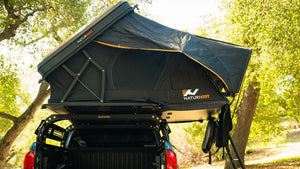
A reinforced aluminum shell, double-layer fabric, and a three-layer sleep system make this a model to consider if you value a sturdy structure and integrated sleeping layers. Its gas-strut-assisted X-Hinge design also keeps setup quick. Check the manufacturer's operating limits before planning a winter trip; these features are not a snow-load or minimum-temperature rating.
ABS
Lighter and cheaper, with fold-out designs that add interior volume for drying gear and moving around. Better for two adults plus kit than for exposed ridgelines.
Space-focused model to compare: Sirius 1 Plus
Consider this option if sleeping space is your priority: its listed mattress measures 205 × 150 cm, and the sleep system includes a foam pad and an anti-condensation pad. Check your vehicle and rack limits against its listed 75 kg weight. The current product description does not specify an ABS shell, so confirm the shell material before choosing it on that basis.
PHC composite
Light and low-profile, which helps on long highway days, in crosswinds, and under a low garage door. The compromise is thermal mass: less of it to buffer temperature swings.
Recommended model: Polaris Aero
A useful option when low weight and a slim packed profile matter. Its specifications list a PHC aluminum honeycomb shell, an aluminum-alloy frame, a 47 kg weight, and a closed height of 10.5 cm. Multiple mesh windows provide ventilation options; plan your insulation separately rather than treating shell material as a warmth rating.
Compare these models with the rest of Naturnest's rooftop tent range, checking vehicle compatibility, packed weight, sleeping dimensions, and the manufacturer's guidance for your expected conditions.
The number that governs: dynamic roof load
A tent that fits is not the same as a tent your roof system can safely support. As explained in Naturnest's Choosing the Right Roof Rack for Your Rooftop Tent, the dynamic load calculation includes the tent, roof rack, mounting hardware, and any roof-mounted gear while driving. When parked, check the static load limits for the tent, occupants, bedding, and gear. Follow the limits provided by your vehicle and roof rack manufacturers rather than assuming one rating applies to both situations.
Extra Gear for a More Comfortable Winter Camp
Thermal Layer
The cheapest single upgrade for a sub-freezing night: it blocks radiation from the cold panel and absorbs the condensation that would otherwise drip.
270 Plus Awning and 90 Straight Pull Awning
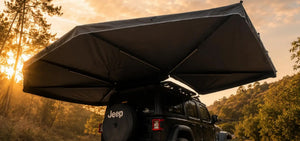
A tent solves sleeping; an awning solves the other fourteen waking hours. The 270 Plus Awning wraps most of the vehicle against sideways weather for cooking and gear sorting; the 90 Straight Pull Awning is the fast, small-coverage option for a one-night stop.
Shower Room
Doubles as a wind-blocked changing space in winter, which is where most heat is actually lost — standing still in the wind, half-dressed.
Keeping Batteries, Water, and Food Ready in the Cold
Batteries lose capacity, not charge
Lithium cells deliver noticeably less usable capacity below freezing, and charging them below 0 °C damages them. Sleep with the power bank and the headlamp in your bag, charge nothing in the cold, and carry a spare set of alkaline cells for the one device you actually need.
Keep water liquid and food unfrozen
Water left in a bottle freezes from the top down; water left in a bladder freezes at the tube first. Store bottles upside down and inside the sleeping bag's footbox. Food goes the other way — an insulated cooler keeps it from freezing solid overnight, which is exactly what you want for the morning coffee.
Your Five-Step Winter Camping Checklist
- Ventilate every night, even at −15 °C. Sealing trades warmth for a wet bag.
- Add a liner and a closed-cell pad; the built-in mattress alone is not enough.
- Never force a frozen latch or hinge. Warm it, or wait.
-
Whenever possible, park with the front of your vehicle facing into the wind to reduce wind exposure on the awning.
- Clear snow off the shell before driving, and fit chains before you need them.
FAQ
How cold is too cold for a rooftop tent?
The shell has no published lower limit; the limiting factor is your sleep system and your willingness to ventilate. Most failures below −15 °C are moisture problems, not insulation problems.
How should I prepare for my first winter rooftop tent trip?
Start with a short trip close to home and an easy route back. Test the tent and your complete sleep system beforehand, check the forecast and road conditions, and arrive with enough daylight to set up. Carry dry spare clothing and have a backup place to sleep if the weather or your equipment is not up to the conditions.
How do I choose the right thermal liner for my tent?
Match the liner to your exact tent model and size rather than choosing by appearance alone. Confirm the attachment points, window and vent access, and whether the liner must be removed before closing the tent. Treat it as an additional layer, not a replacement for a suitable sleeping bag, insulated sleeping pad, or ventilation.
What should I do if I have to pack the tent away damp?
Remove loose snow and wipe away accessible moisture without forcing frozen fabric or hardware. If you must close the tent while it is damp, reopen it as soon as practical in a suitable dry location. Air the fabric, mattress underside, and any removable liner, and let everything dry fully before long-term storage. Follow your model's cleaning and care instructions.
Get Ready for Your Next Winter Trip
Fix the weakest layer first: pad, then liner, then ventilation. Browse the rooftop tent collection, compare the Polaris series, and add a liner before your first sub-freezing night.