- Sep 27
- By FuAmelia
Choosing between three rooftop tents with a similar clamshell shape can be harder than it first appears. The Polaris Plus, Polaris Lite, and Polaris 2 are all two-person, four-season hard-shell rooftop tents, and they share many of the features campers use most often.
All three models use the same mattress and base tent-fabric material. They also include LED lighting, a telescoping ladder, mesh ventilation, interior storage, exterior shoe bags, and a heater/cooler port.
The meaningful differences are found elsewhere: shell construction, total weight, closed height, interior space, condensation management, included Luggage bars, power connections, and exterior styling.
The short answer is simple:
-
Choose Polaris Plus for a full-featured aluminum design, included Luggage bars, equipment expansion, and an all-black exterior.
-
Choose Polaris Lite if lower weight and a slimmer closed profile are your highest priorities.
-
Choose Polaris 2 for its double-layer fabric, extended interior space, and condensation-focused design.
Here is how those differences affect real camping.
Polaris Plus vs. Polaris Lite vs. Polaris 2 at a Glance
The following table focuses on the differences that are most likely to affect your buying decision.
| Key Difference | Polaris Plus | Polaris Lite | Polaris 2 |
|---|---|---|---|
| Shell | Aluminum alloy | PHC composite | Aluminum alloy |
| Weight | 165.65 lb / 75.14 kg | 120.6 lb / 54.46 kg | 170.85 lb / 77.5 kg |
| Closed height | 7.09 in / 18 cm | 4.3 in / 11 cm | 7.09 in / 18 cm |
| Main advantage | Full-featured aluminum design | Lightweight and ultra-slim | Double-layer fabric and extended interior |
| Luggage bars | 2 included | Optional | 2 included |
| Best for | Gear expansion and all-black builds | Long-distance and weight-conscious travel | Humid conditions and more interior room |
The three models share more similarities than this table may suggest. Each sleeps two people and uses the same mattress and base tent-fabric material. Each also follows the same basic camping routine: release the latches, allow the gas struts to raise the shell, extend the ladder, and arrange the entrance and ventilation panels.
That means the decision should not be based on mattress comfort or fabric grade. Instead, consider how much weight your vehicle can safely carry, how much closed height you are willing to add, how much equipment you travel with, and where you normally camp.
Meet the Three Polaris Rooftop Tents
Polaris Plus: Full-Featured Aluminum Design
The Polaris Plus is the full-featured aluminum option in the lineup.
Its aluminum-alloy shell and reinforced corners are designed for campers who prefer the rigidity and long-term durability of a metal hard shell. At 165.65 pounds, it is heavier than the composite Polaris Lite but slightly lighter than the Polaris 2.
Equipment expansion is one of its strongest selling points. Two Luggage bars are included, and the tent also features dual accessory tracks. This gives campers more flexibility when carrying compatible outdoor equipment or building a more complete overlanding setup.
The presence of Luggage bars does not remove the need to check load limits. The weight of the tent, bars, mounting hardware, and additional equipment must remain within both the vehicle and rack manufacturer’s ratings. Solar-panel mounting also requires compatible hardware and appropriate weight distribution.
Polaris Plus currently lists USB and Anderson power connections, along with LED lighting and a heater/cooler port. It also provides extensive interior organization through overhead pockets, side storage, and exterior shoe bags.
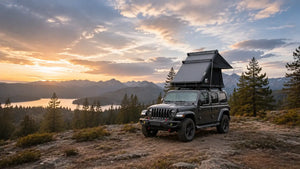
Its other clear distinction is appearance. The black shell and Night Black tent fabric create a consistent blackout look that pairs naturally with dark-colored SUVs, Jeeps, pickups, and overland builds.
Polaris Plus is therefore best for campers who want an aluminum shell, included cargo expansion, integrated power connections, organized interior storage, and a clean all-black design.

Polaris Lite: Lightweight and Ultra-Slim
The Polaris Lite takes a different approach. Instead of using an aluminum shell, it uses a PHC composite shell with an aluminum frame.
Its most important advantage is weight. At 120.6 pounds, Polaris Lite is approximately 45.6 pounds lighter than Polaris Plus and 50.3 pounds lighter than Polaris 2.
That difference can be important for vehicles with more limited dynamic roof-load capacity. Lower weight can also make installation and removal easier and reduce the amount of mass carried high above the vehicle’s center of gravity.
Polaris Lite also has the lowest closed profile in the group. It measures approximately 4.3 inches high when closed, compared with 7.09 inches for the other two models. The slimmer shape reduces the amount of height added to the vehicle and may be helpful for garages, covered parking, low branches, and other clearance-sensitive situations.
A lower profile also presents a smaller frontal area while driving. Actual effects on wind noise and fuel consumption will vary by vehicle, rack system, speed, and installation, so a specific fuel-economy improvement should not be promised.
When open, Polaris Lite reaches approximately 63.38 inches high, while Plus and Polaris 2 reach about 59.06 inches. This gives Lite additional vertical space near the raised end of the tent.
Unlike Plus and Polaris 2, its Luggage bars are optional rather than standard. That makes sense for its lightweight positioning: buyers who do not need to carry equipment on top avoid adding unnecessary hardware and weight.
Polaris Lite is best for long-distance travelers, weight-conscious campers, vehicles with more limited roof capacity, and anyone who prioritizes a thin closed profile over included cargo equipment.

Polaris 2: Double-Layer Fabric and Extended Interior
The Polaris 2 is designed around two concerns that become especially noticeable on longer trips: interior space and condensation.
All three models use the same base tent-fabric material, but Polaris 2 adds a second fabric layer. The air gap between the two layers provides additional separation between the interior and the colder outer surface.
This double-layer fabric helps reduce condensation buildup in cold or humid conditions. It should not be described as completely condensation-proof, since occupant breathing, wet clothing, outside humidity, temperature differences, and ventilation all affect moisture inside a rooftop tent. Campers should still open appropriate vents whenever conditions allow.
Polaris 2 also uses an extended interior design that provides additional room around the head and feet. This can make a meaningful difference for two people, especially when bedding and small pieces of equipment are kept inside.
Like Polaris Plus, Polaris 2 uses an aluminum-alloy shell and includes two Luggage bars. It also lists USB and Anderson power connections, LED lighting, storage pockets, shoe bags, and a heater/cooler port.
At 170.85 pounds, Polaris 2 is the heaviest model in this comparison. Buyers should account for that weight as well as anything installed on the Luggage bars.
Visually, it pairs a black shell with Military Green tent fabric. The result is a more traditional outdoor and overlanding appearance than the all-black Polaris Plus.
Polaris 2 is best for couples who want more usable interior room and campers who frequently travel in cold, damp, or high-humidity environments.

The Differences That Matter at Camp
Shell material is the first major decision. Polaris Plus and Polaris 2 use aluminum shells, while Polaris Lite uses a PHC composite shell. The aluminum models emphasize rigid construction and integrated equipment expansion. The composite model emphasizes reduced weight, a thinner profile, and thermal separation.
Vehicle load is equally important. The listed tent weight is only part of the calculation. A complete rooftop load can include:
-
The tent
-
Mounting hardware
-
Crossbars or a platform
-
Luggage bars
-
Solar equipment
-
Tools or recovery gear
-
Other cargo
Check both the vehicle’s dynamic roof-load rating and the rack system’s rating before installation. A vehicle may support more stationary weight at camp than it can safely carry while moving.
Closed height matters most during travel. Polaris Lite’s 4.3-inch profile is the clear advantage for drivers concerned about total vehicle height. Plus and Polaris 2 have the same listed closed height of 7.09 inches.
Interior space is more nuanced. Polaris Lite provides the greatest listed opening height, while Polaris 2 uses an extended shape to increase usable room near the head and feet. One favors vertical clearance; the other focuses on lengthwise living space.
For humid-weather use, Polaris 2 has the most relevant design difference because of its double-layer fabric. The advantage comes from the additional layer—not from a different base fabric material.
Cargo requirements create another clear dividing line. Plus and Polaris 2 include two Luggage bars, while they are optional for Lite. Campers who do not carry equipment above the tent may prefer the lighter, simpler Lite configuration. Those building a gear-heavy overlanding setup may find the included bars on Plus or Polaris 2 more convenient.
Which Polaris Tent Fits Your Camping Style?
Choose Polaris Plus if your trips involve more equipment and you want a complete aluminum setup from the beginning. Its included Luggage bars, accessory tracks, power connections, storage, and all-black appearance make it a strong match for organized overland builds.
Choose Polaris Lite if most of your driving happens on highways or long-distance routes. Its lower weight and thinner profile reduce the amount of mass and height added to the vehicle. It is also a practical choice when the vehicle or rack has a more restrictive dynamic load rating.
Choose Polaris 2 if you regularly camp in humid regions, experience large overnight temperature changes, or want more room around your head and feet. Its double-layer fabric helps manage condensation, while the extended interior provides more usable sleeping space.
For minimalist campers, Lite is likely the most natural fit. For equipment-heavy travelers, Plus and Polaris 2 offer more standard expansion. For buyers building an all-black vehicle, Plus provides the most consistent visual match.

Frequently Asked Questions
Do all three Polaris models use the same mattress and tent fabric?
Yes. All three use the same mattress and base tent-fabric material. Polaris 2 differs by adding a second fabric layer rather than using a different base material.
What is the benefit of Polaris 2’s double-layer fabric?
The second layer creates an insulating air gap that helps reduce condensation buildup in cold or humid conditions. It does not eliminate the need for ventilation.
Which Polaris rooftop tent is the lightest and thinnest?
Polaris Lite is the lightest at approximately 120.6 pounds and the thinnest when closed at approximately 4.3 inches.
Which models include Luggage bars?
Polaris Plus and Polaris 2 each include two Luggage bars. Luggage bars are optional for Polaris Lite.
Do all three tents have a heater/cooler port?
Yes. Each model includes a heater/cooler port. A compatible heating or cooling device and a suitable power source may need to be purchased separately.
Will these tents fit every SUV or pickup?
No. Compatibility depends on the vehicle’s dynamic roof-load rating, rack capacity, crossbar spacing, mounting hardware, and total installed weight. Always verify the current vehicle and rack requirements before installation.